Your source for the best and most complete learning
resources on healing traditions East and West

Free Shipping!

when purchasing $150.00 or more
(on orders delivered within the United States)

Welcome to Redwing Books Online where you can search, browse and purchase our books on health and wellness.

Create an account to make checking out fast and easy. Already have an account? Click here to login.
Do you receive our catalog or e-mail newsletter? To signup, click here.

Enlarge

Hardcover book

556 pages, 811.00 x null"

ISBN 9780443045820

SKU: PraDiaTCM

Includes

With index
With bibliography
With footnotes
With appendix

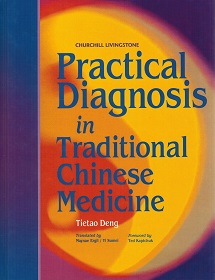
Practical Diagnosis in TCM

By (author)  Tie Tao Deng
By (author)  Marnae Ergil

Availability: Usually ships within 1-2 business days.

Hardcover book | $189.00
Practical Diagnosis in Traditional Chinese Medicine is the first book of its kind to be translated into English and it fills an important gap in classroom textbooks. Chinese medical education in China includes at least one semester of study that is focused solely on diagnostics - on the 4 examination methods. Following this, students progress into courses of pattern identification. Next they begin to work with assimilating all of the information gained through the 4 examinations and figuring out which theoretical lens is appropriate for determining a diagnosis.

This book takes the student through each of these steps. It begins with an extensive discussion of the four examination methods. This first section contains information about pulses and tongues not previously available in English, but more importantly for the student, it discusses the mechanisms which underlie each pulse or tongue, why one would ask particular questions and what the relevance for diagnosis is. It goes far beyond the currently available texts in fundamental theory to give the student a much more solid and informed position from which to begin the diagnostic process. The second section then discusses the various different lenses through which a practitioner might look at a pattern. This section starts with the basics, such as the Eight parameters, and then advances to a discussion of organ pathology, six channel pattern identification (from the Shang Han Lun), 4 Aspects pattern identification (based on Wen Bing theory), triple burner pathologies and more. Finally, the text examines specific presenting symptoms such as cough, wheezing, cold, heat effusion, etc.

Essentially, this text can be used by the student beginning after their fundamental theory coursework all the way through diagnostics, pattern identification and symptom analysis. There has long been a gap in available textbooks which covered this type of information - more in depth and comprehensive than fundamental theory, but not inclusive of treatment recommendations. This is an area which has been passed over in the writing of English language textbooks but which is of primary importance in China.

-Marane Ergil, the translator.

Main Description

This text is distinguished by its authority, authenticity, and completeness. Most diagnostic information in English is abstracted rather than translated from Chinese sources and is typically abbreviated to fit the limits of general survey texts for beginners. Practical Diagnosis differs from these presentations as it is an English presentation of the entire Chinese language work compiled by one of China's most respected living physicians. The English edition is a complete translation of the text used in China with neither abstraction nor simplification.

The book is in six major sections with information presented from the general to the specific allowing the reader to understand the many details in context. The first section describes the four examinations. The second covers eight principle; disease cause; six channel; four aspect; qi, blood and fluid; viscera and bowel, and channel and network vessel patterns. The third section concentrates on the application of these patterns in practice, including a small but unique chapters giving a step-by-step approach to determining treatment from the pattern and the differentiation of various conditions that are treated as fixed-entity diseases. The fourth section describes the application of traditional diagnostic principles in the gynecology, pediatrics, external medicine, traumatology, opthamology, and EENT clinics. This is followed in section five with an explanation of 25 commonly-seen clinical symptoms and, in section six, an explanation of the standard in- and out-patient medical record and how to prepare one. Several pages are devoted to clinical observations in external medicine, and there are chapter-ending tables that review differentiations in useful detail. In each chapter there are differentiations of what may and what must be clinically observed before a pattern can be identified with confidence. Throughout, the book is distinguished by the both the extent and depth of its detail.